A CONSTELLATION OF PURPOSE
STELLA is the result of three disciplines guided by a single pursuit of truth in sound.
Astell&Kern represents the precision of modern engineering. VOLK Audio defines the architecture of design
and acoustic form. Michael Graves brings the mastery of a five-time GRAMMY Award-winning engineer who
understands the line between control and emotion.
Led by VOLK founder Jack Vang, whose decade of experience helped shape a generation of in-ear design, the
project evolved through exchange and refinement. Each discipline strengthened the others, creating an
instrument defined by proportion, balance, and restraint.
Throughout development, the VOLK engineering team worked closely with Astell&Kern to advance both process
and performance. New acoustic architectures and driver assemblies were created specifically for STELLA to
achieve the precision and tonal balance defined in its target response.
These innovations were refined and calibrated through extensive sessions with Michael Graves at Osiris
Studio in Los Angeles. Each evaluation focused on tonal accuracy, phase alignment, and spatial coherence,
ensuring that every decision served the music itself.


“ This collaboration was both an honor and a challenge that demanded absolute precision. Both
Astell&Kern’s and Michael Graves’ standards for excellence mirror our own, and that alignment pushed
every part of the process to its limits. The goal was to create something focused, balanced, and
precise, an IEM accurate enough for the most demanding mastering environments yet engaging enough for
personal listening.
STELLA carries that philosophy forward, a reflection of what’s possible when
precision meets purpose. ”
STELLA is built on a 12-driver quadbrid architecture that unites four transducer
technologies
within a single, coherent system.
Each element was developed for its distinct role and tuned through precise control of phase,
pressure,
and motion.
Its design reflects the same discipline that governs its form. Every contour, cavity, and
circuit exists
to serve acoustic integrity. The structure is shaped by performance, the performance defined by
structure. Nothing is decorative, nothing is redundant.
Every driver operates within its natural range, contributing its character without interference.
No
forced equalization. No artificial enhancement. Only precision through purpose.
"Michael Graves is a multiple GRAMMY® Award–winning mastering engineer.
Since 2002, he has worked with clients worldwide and is recognized as one of today’s foremost specialists in
audio restoration and re-mastering, earning 5 GRAMMY Awards and 17 nominations.
His work on new and old recordings with labels such as Omnivore Recordings, Numero Group, Dust-to-Digital,
BMG, Craft Recordings, and Analog Africa, has helped shape the sound of artists including Blondie, Aretha
Franklin, Hank Williams, Nina Simone, Erroll Garner, Ray Charles, Art Pepper, Janis Joplin, Buck Owens and
many more.
Graves owns and operates Osiris Studio, a Los Angeles-based mastering and audio-restoration services
facility that provides audio services to the entertainment and archival communities.“
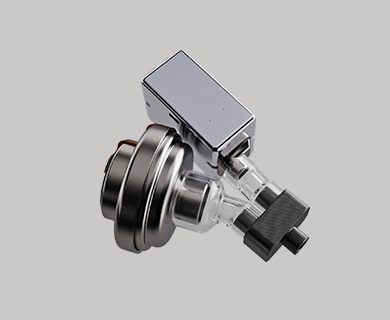
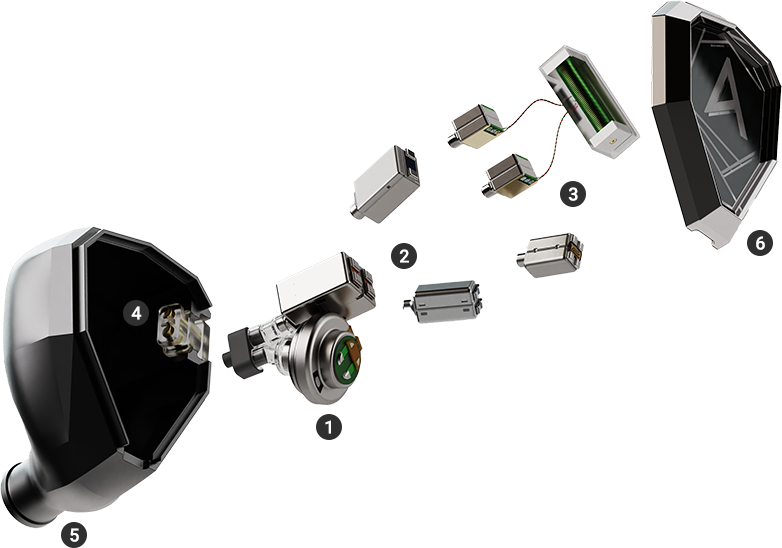
The VOLK Low-Frequency Hybrid System (LF-H) serves as the starting point of STELLA’s
multi-stage architecture, combining VOLK’s M9-R 9 mm subwoofer and dual balanced armatures within a
dual-stage chamber designed to regulate phase and resonance.
The chamber’s geometry, alignment, and crossover were co-developed to maintain phase accuracy and
pressure balance between both stages. This coordination allows the dynamic driver to deliver depth
and force while the armatures add speed, texture, and tonal structure across the lower band.
Operating from 20 to 600 Hz, the LF-H establishes a foundation of weight and control that defines
STELLA’s composure and balance.
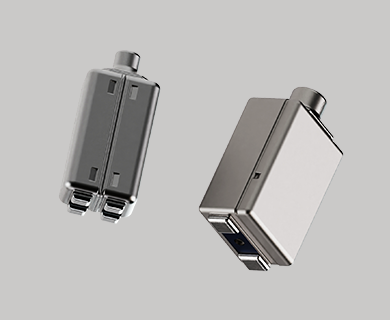
STELLA’s midrange is formed around a tri-armature array tuned for tonal balance and
natural presence.
The dual balanced-armature drivers operate from 600 Hz to 7 kHz, voiced for energy and density in
the 1–5 kHz range. They deliver warmth, articulation, and a vocal character that connects the low
and high ranges with quiet precision.
Above them, a single armature extends from 6 to 15 kHz, overlapping to reinforce upper-mid harmonics
and refine vocal and instrumental overtones. Its lightweight diaphragm and quick transient response
preserve clarity and texture while integrating precisely with the planar and electrostatic systems
above, maintaining linearity across the spectrum.
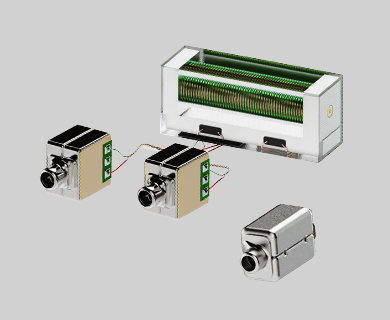
The VOLK High-Frequency Hybrid System (HF-H) defines the upper range of STELLA’s
architecture, combining VOLK’s MP-2 dual planar magnetic drivers with four electrostatic tweeters in
a unified system.
The crossover and acoustic topology were co-engineered to preserve phase accuracy and tonal
stability across the transition between the planar and electrostatic assemblies. This balance allows
the planars to shape upper harmonics with precision and control while the electrostatics extend
bandwidth and atmosphere with speed and composure.
Operating from 9 to 45 kHz, the HF-H maintains coherence and clarity at the limits of extension,
completing STELLA’s spectrum with authority and refinement.
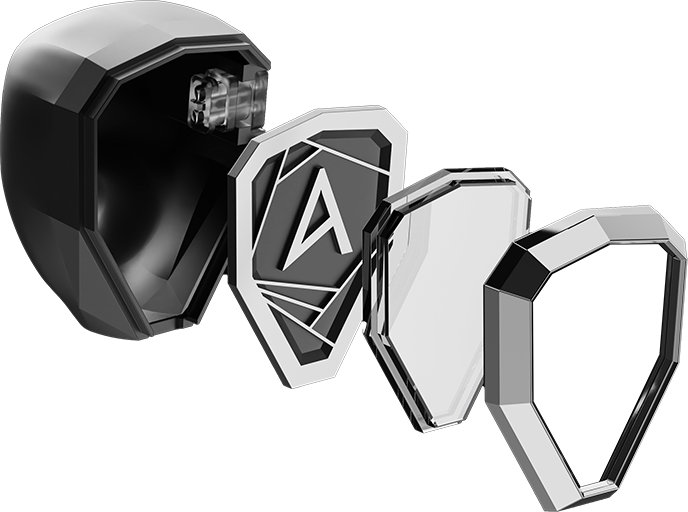
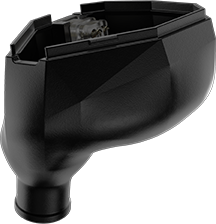
Machined from aerospace-grade 6061-T6 aluminum and anodized in satin black, the shell forms the structural core of STELLA. It holds every acoustic element in precise alignment, maintaining stability between the driver assemblies and the enclosure. Its geometry is engineered for stiffness and resonance control. Internal mass and surface continuity stabilize the structure, reducing vibration and preserving acoustic accuracy. The alloy’s low density provides comfort while preserving strength and balance.

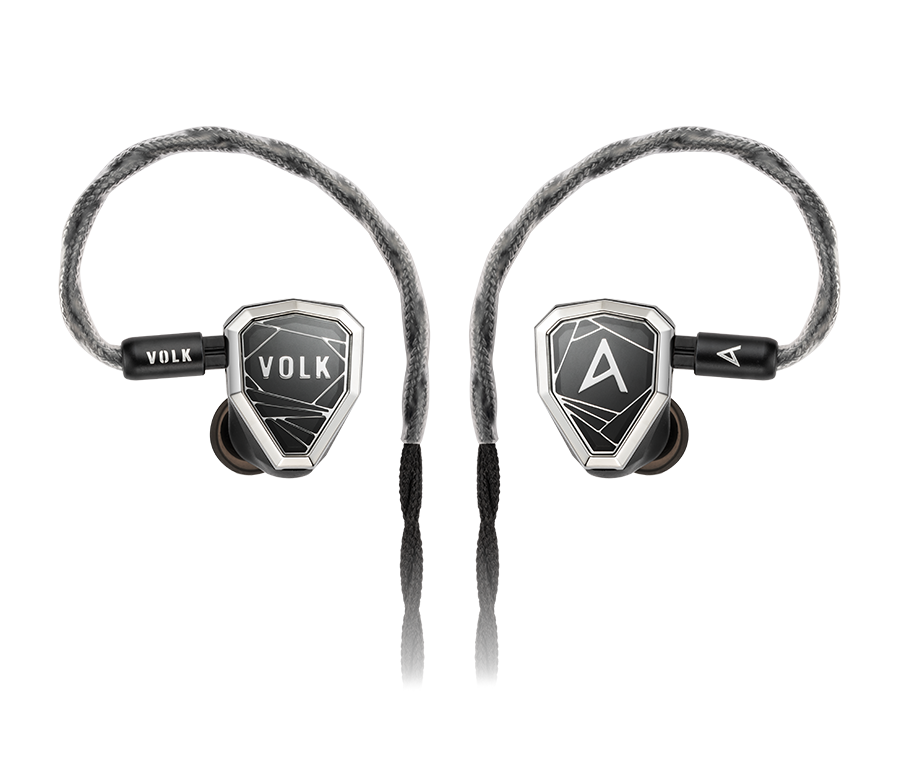
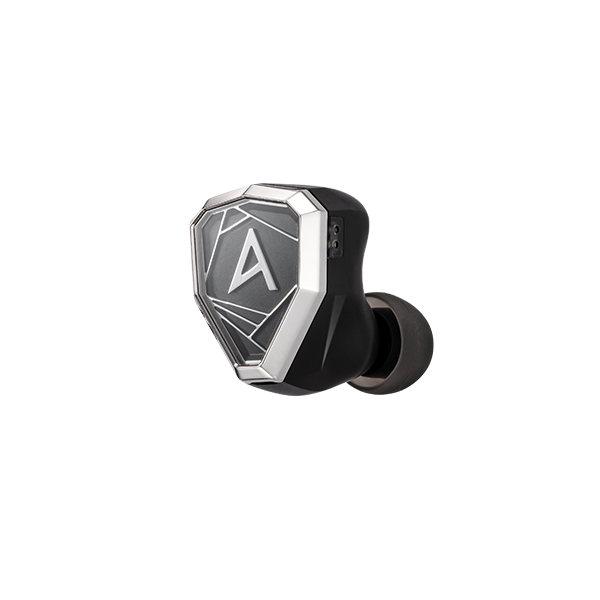
Machined from 6061-T6 aluminum and finished in satin black, the central plate forms the visual and structural centerpiece of STELLA. Positioned between the shell and the frame, it maintains geometric balance across the assembly. The VOLK and Astell&Kern insignias rest in opposition, each centered within its own field. The constellations surrounding them trace independent paths yet follow the same proportion and order. It is both ornament and structure — the expression of balance and craftsmanship that defines STELLA.
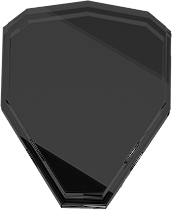
Cut from a single block of optical-grade 9H sapphire crystal glass, the panel completes STELLA’s faceplate assembly, uniting the stainless-steel frame and central plate into a single, sealed structure. The surface is then diamond-polished to eliminate micro-distortion, achieving complete transparency and visual purity. The result is a structural lens of pure sapphire, engineered for rigidity, precision, and continuity of form

The frame defines the structural boundary between the sapphire glass and the aluminum chassis, machined to micron precision from stainless steel. Each surface is polished to a mirror finish, reflecting the precision of its form and the materials it unites. Beyond structure, it regulates the interface between air and material. The venting architecture built into the frame equalizes internal pressure and suppresses resonance, maintaining balance across the entire acoustic system. Every edge, radius, and transition was modeled to direct light and form as one continuous surface.
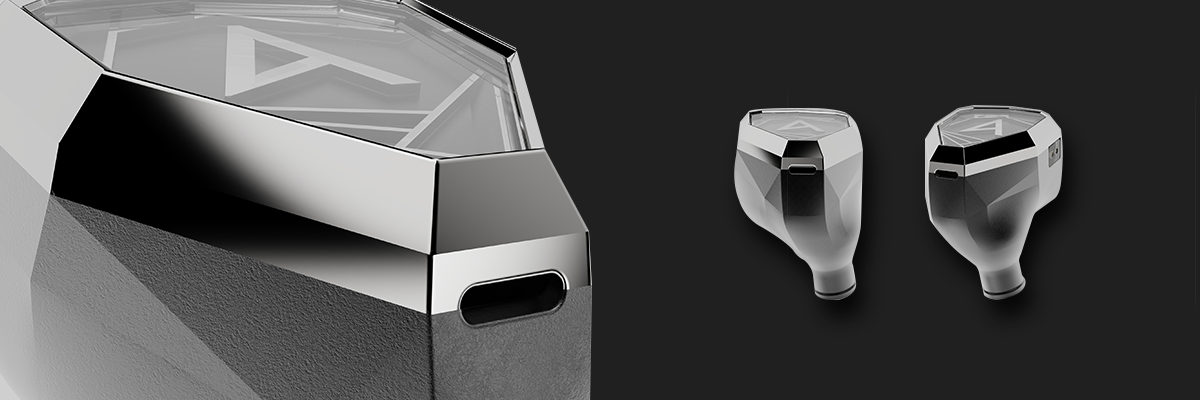
Machined into the aluminum shell and stainless-steel frame, the vent system regulates airflow throughout the enclosure. Its geometry equalizes internal pressure, stabilizing diaphragm motion and maintaining linear driver response. Each aperture is defined by depth, diameter, and damping profile to balance pressure relief and isolation. This prevents standing waves and suppresses low-frequency bloom while preserving the integrity of the acoustic chamber. The vents function as a unified pressure-control system, ensuring consistency between both channels and completing STELLA’s structural and acoustic equilibrium.
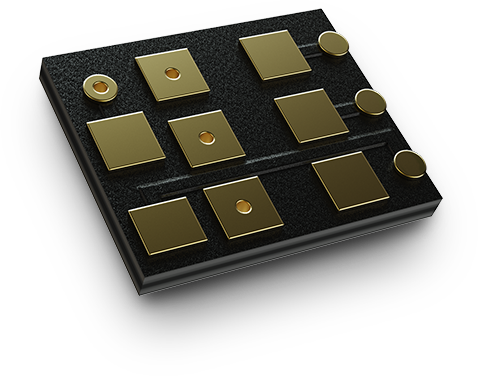
Stella features a proprietary six-way network that preserves phase integrity and synergy across all driver groups. Each acoustic path is filtered and time-aligned to maintain spatial coherence and tonal stability through the full frequency spectrum.
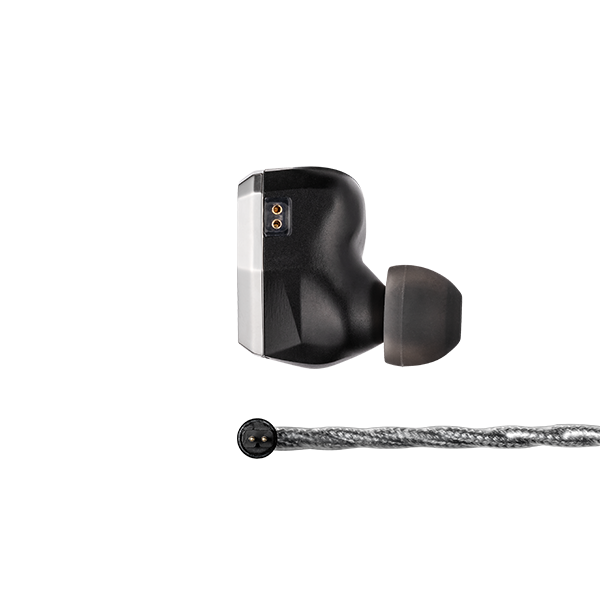
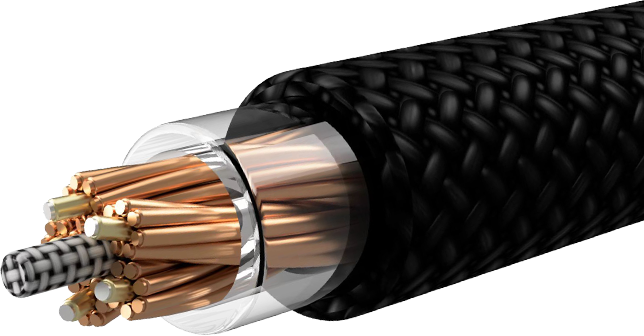
Designed as an integral part of STELLA’s acoustic system, the cable preserves signal integrity and linearity across the full range, maintaining equilibrium between structure and sound.
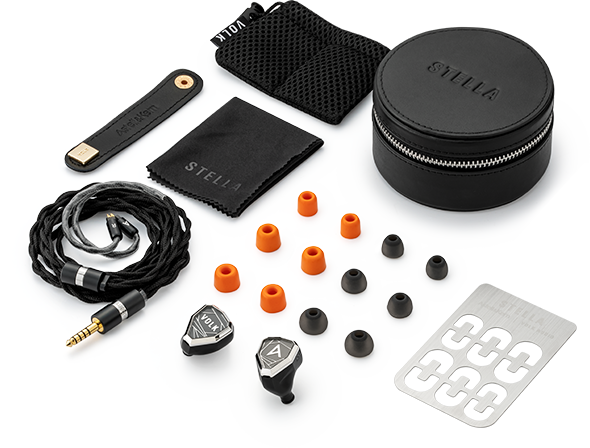
· STELLA Earbud L/R
· Hybrid Conductor Array : 5N LCOFC Copper, 4N Silver and 24K Gold (2pin, 4.4mm)
· 3 Pairs of Silicone Ear Tips (S/M/L)
· 3 Pairs of Foam Ear Tips (S/M/L)
· IEM Pouch
· Cable Holder
· Leather Carrying Case x1